



The art of Iaido
Iaido is generally described as the art of smoothly drawing and cutting with the Japanese sword. The Japanese sword is often regarded as the soul of the samurai (bushi) and is deeply connected to the history and culture of Japan.
Although sword techniques were mentioned early in Japanese history and were primarily used in warfare, the classical sword schools in Japan, known as ryuha, emerged during the 16th and 17th centuries. During this period, military techniques were transformed into martial arts (bugei), largely influenced by Zen Buddhist philosophy. This represented a shift from purely functional combat skills to more abstract and artistic techniques. The masters’ techniques were codified and passed down to students, initially through oral instruction and later in secret written scrolls.
The kata were regarded as authoritative. They conveyed the principles and standards that students had to memorize, enabling them to understand not only the movements but also the spirit of their master’s style.*
*More information about the history of sword techniques can be found in this highly recommended book: Hurst, G. Cameron. (1998). Armed martial arts of Japan: swordsmanship and archery. New Haven: Yale University Press.
The art of Chi Ryu Iaido
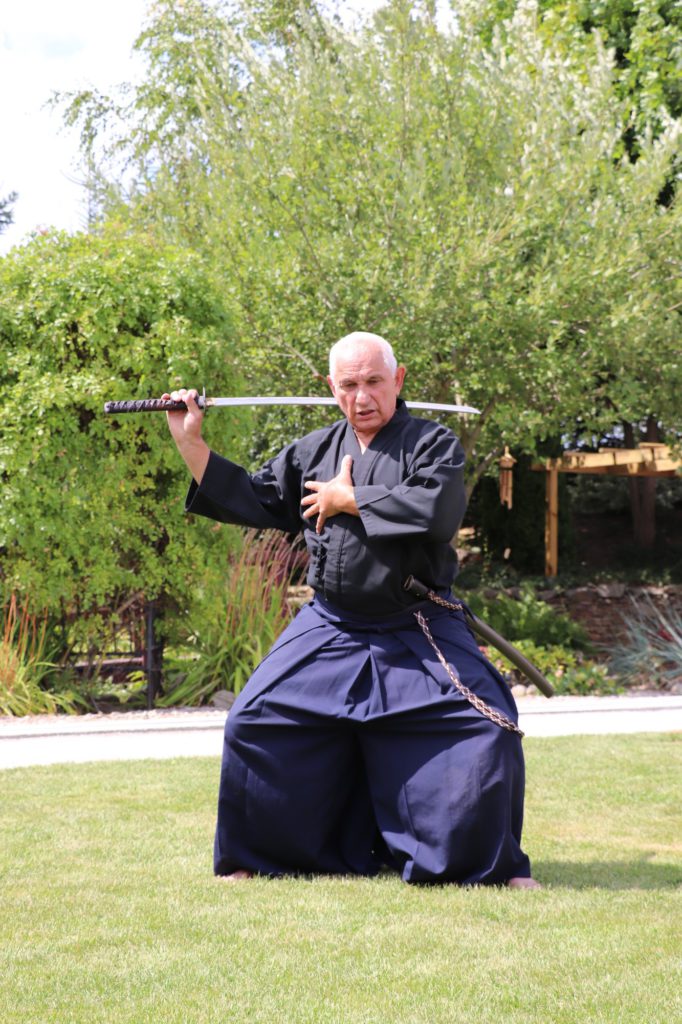
Chi Ryu Iaido is one of the classical ryuha (traditional schools) of Japanese swordsmanship. However, it is distinguished by techniques that could have been used by a samurai in practical situations. These are not merely artistic forms; they are applicable techniques designed for specific scenarios and are practiced with a partner.
Hanshi Bernaschewice began his study of Iaido in the late 1970s. He trained under Fujii Okimitsu Sensei and Haruna Matsuo Sensei, who became the foundational teachers for the style we now know as Chi Ryu Iaido. He regarded both masters as his sensei and studied their teachings in Europe as well as in Japan. After their passing, many questions remained, which led Hanshi Bernaschewice, later in life, to return to Japan in search of further understanding. He studied extensively within classical ryuha, adhering to their rules and principles. Yet, many questions remained unanswered, ultimately leading to the creation of Chi Ryu Iaido.
Today, Chi Ryu Iaido shows the influence of Muso Jikiden Eishin Ryu, Mugai Ryu, and Niten Ichi Ryu within its techniques.
The techniques are transmitted across three levels:
Shoden
Shoden is the beginner level. At this stage, students learn the basic movements and techniques of the school. It serves as a solid foundation on which more advanced techniques are built in the subsequent levels.
Chūden
Chūden is the intermediate level. At this stage, students master all intermediate techniques, become proficient in bunkai (sometimes referred to as shiai or paired exercises), and develop knowledge of the school’s philosophy and history.
Okuden
Okuden is the inner or advanced level. At this stage, the highest and most secret teachings and techniques of the school are transmitted to the student.
Training
Ashi Waza
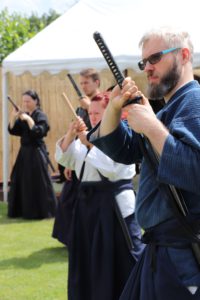
The ashi waza (foot techniques) form the foundation of all movements in Chi Ryu Iaido. Great importance is placed on walking correctly, both in kihon and kata. Every class begins with practicing the seven basic principles of ashi waza.
Suburi
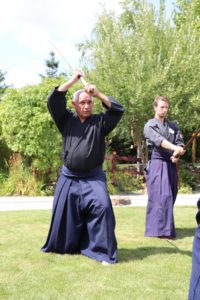
Suburi refers to cutting exercises performed with full power. Students practice both the correct grip (tenouchi) and the cutting technique in combination with the previously studied ashi waza. The set of suburi varies depending on the techniques being practiced during the lesson.
Kihon
Kihon are the basic techniques. Here, students are introduced to the various ryuha that have influenced Chi Ryu Iaido. We practice the four fundamental principles of Iaido according to the characteristics of these schools:
-
Nukitsuke – drawing the sword, followed by a cutting strike
-
Kiritsuke – the cutting or thrusting strike after nukitsuke
-
Chiburi – shaking off the blood from the blade
-
Noto – returning the sword to the scabbard
Kata
As in every traditional martial art, kata represents the core of the school. A kata is a set of techniques performed in a strict sequence and precise manner. Kata exist for all three levels: Shoden, Chūden, and Okuden.
Bunkai
Bunkai deepens our understanding of kata by applying the techniques in partner exercises. Bunkai techniques are practiced at all three levels: Shoden, Chūden, and Okuden.
Tameshigiri
On special occasions, our techniques are put to the test in tameshigiri, where we practice cutting techniques. Historically, during the Edo period, tameshigiri was performed on living targets to test swords. Today, this is no longer practiced. Instead, soaked and rolled tatami mats are used to safely test cutting techniques.
The future of Chi Ryu Iaido
Shihan Kathrin Siggelkow (Bernaschewice) serves as the technical authority for Chi Ryu Iaido, guiding its continued development while faithfully preserving the principles, techniques, and spirit established by Hanshi Jhonny Bernaschewice. Under her leadership, the curriculum—including kihon, kata, bunkai, and tameshigiri—is taught with precision, discipline, and a deep respect for tradition.
Through seminars, workshops, and international training opportunities, Shihan Kathrin ensures that students worldwide can study the art in depth, experiencing both its technical richness and philosophical foundations. Her guidance balances careful innovation with the preservation of traditional values, ensuring that Chi Ryu Iaido continues to grow, inspire, and pass on its legacy to future generations.
