


Okinawa Kobudo (literally “the ancient martial art of Okinawa”), as practiced in our Federation is closely related to the Matayoshi Kobudo of Shinko and Shinpo Matayoshi. It encompasses the weapon systems developed in Okinawa, with Matayoshi Kobudo being one of the many styles that originated on the island.
This page presents excerpts from an article examining the development and historical background of Matayoshi Kobudo. It is our own summary of the English article: Lohse, Fred. (2007). Matayoshi Kobudo. pp. 2–15 in: Meibukan Magazine,No. 9, September 2007. Lent, The Netherlands.
All excerpts are clearly marked for reference.

Development of Matayoshi Kobudo
“[…] In many ways, the Matayoshi Kobudo tradition is a classic example of the syncretic development common to most martial arts in Okinawa. The technical elements of the system are rooted in the martial arts of the Ryukyu Kingdom period, which Shinko Matayoshi studied. These are based on family traditions, including ekujutsu from Tsuken-jima and Okinawan bo forms such as Yonegawa, as well as the sai, kama, bo, and eku techniques of Agena, the tonfa and nunchiyaku of Ire, and the bo techniques of Yamane, Shishi, and Oshiro.
To these more indigenous Okinawan elements, Shinko Matayoshi added techniques he learned in Manchuria—which he also studied in Shanghai—including the White Crane style of Gokenki, and especially the unarmed and armed techniques of Master Kingai, such as nunti, tinbe, sansetsukon, and suruchin. Shinko Matayoshi combined these diverse elements into a more coherent system, a body of knowledge that he passed on to a select number of students and to his son.
However, the development of the system did not stop there. Like his father, and indeed like most founders of modern Okinawan systems, Shinpo Matayoshi also had multiple teachers. From his father, he learned the various techniques of the Ryukyu Kingdom period as well as Kingai’s material. Additionally, he studied Karate and bojutsu with Chotoku Kyan, Goju-Ryu with Miyagi and especially Seiko Higa, and White Crane with Gokenki. He also participated in exchanges with various practitioners across Okinawa, including other students of his father. When he returned to Okinawa in 1960, he began shaping these diverse influences into the more coherent system that was present in his dojo during the later years of his life.”
While the development of the system can be easily summarized by stating that Shinpo Matayoshi inherited it from his father and taught it to his students, such a description would eliminate much of its true depth and cultural value. In the years leading up to the establishment of the Zen Okinawa Kobudo Renmei, Shinpo and his students and training partners spent significant time refining and formalizing the system. Some of the original members had trained under his father or under other students of his father (for example, Seikichi Odo was a student of Mitsuo Kakazu, who was a student of Shinko Matayoshi), as well as under other Kobudo teachers. Others had already trained with him for more than ten years. While Shinpo was the leader, head instructor, and technical director, there was extensive collaborative work on the system’s content. Together, under his guidance, they formalized the kata system, made decisions about what to include or exclude, and created sets of kihon for the basic weapons, among other tasks. […] (Lohse, 2007, pp. 7–8).
Lohse (2007, pp. 8–9) also notes that during this period, a number of kata were formalized based on these techniques and emphasizes that there has always been change and a creative approach to the foundational material.
“[…] According to his most experienced students, Matayoshi Shinpo constantly worked with his material, developed his techniques, and occasionally added elements from his father’s teachings. According to some of these senior students, there were still many things he had not taught anyone. […]” (Lohse, 2007, p. 9).
Matayoshi Shinpo Sensei passed away on September 7, 1997, at the age of 76. His passing left a significant void in the Okinawan martial arts community.
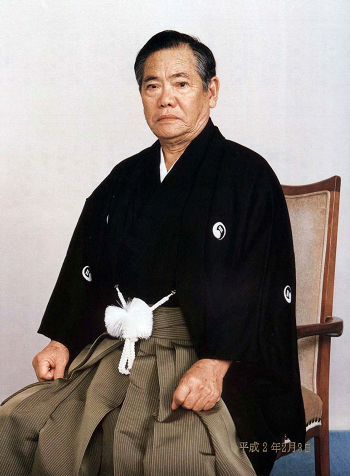
Photo credit: Zen Okinawa Kobudo Renmei. (1999). Matayoshi Shinpo Sensei Tsuitou. (Memorial for Sensei Matayoshi Shinpo). p. 0.

Training
Kihon
As described above, each weapon in Matayoshi Kobudo has a set of basic techniques known as hojundo. These form the foundation of every lesson and are studied in detail.
Kata
As in every traditional martial art, kata represents the core and heart of the system. A kata is a sequence of techniques performed in a strict order and precise manner. The practice of kata is central to the Matayoshi Kobudo system and is encouraged from an early age.
Kumiwaza and Oyo
Training is further deepened through applied exercises of kata or kihon with a partner (kumiwaza) or with multiple partners (oyo), allowing students to explore the practical applications of the techniques.
The future of Okinawa Kobudo in our Federation
Okinawa Kobudo in our Federation continues to thrive under the dedicated leadership of Shihan Peter Scholz. With decades of experience and deep knowledge of traditional weapon systems, Shihan Scholz serves as the technical authority for Okinawa Kobudo, ensuring that the rich legacy of Hanshi Bernaschewice’ teachings of Okinawa Kobudo is preserved, taught, and passed on with the utmost fidelity.
Under his guidance, the Federation maintains a rigorous training curriculum that includes kihon, kata, kumiwaza, and oyo, emphasizing precision, control, and the practical application of techniques.
Through seminars, workshops, and international exchanges, Shihan Scholz ensures that students at all levels have the opportunity to study Okinawa Kobudo deeply, learning not only the techniques but also the philosophy, history, and cultural significance behind them. His leadership guarantees that Okinawa Kobudo within our Federation will continue to grow, inspire, and pass on its rich heritage to future generations.
